 +420 571 612 420
 gds@gds.cz


 EN
EN
 CZ
CZ
 hu
hu
 bg
bg
 fr
fr
 ro
ro


The choice of the sandblastercartridge has a major influence on the final appearance of the glass. What material to choose, what fraction to use and what to watch out for when working with stencils? Below we have prepared a handy overview to help you with your choice.
Refills for sandblasters and which one to choose for working with glass
Abrasive vs. non-abrasive materials
The basic division of fillings is simple:
- Abrasive: they remove material from the surface (typically creating matte, texture, depth).
- Non-abrasive: Rather, they clean, unify or modify the surface without matting the glass
Abrasives most commonly used for glass
In our conditions, corundum is most commonly used.
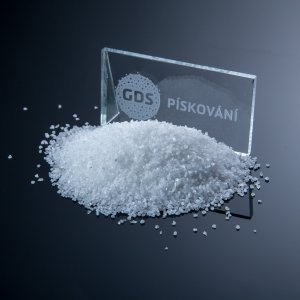
A) White corundum
A chemically pure material that does not contaminate the glass when sandblasted. Ideal for decorative work on glass.
B) Brown corundum
Very widespread and popular. Fully usable for glass, but can leave marks when sandblasting stainless steel, for example. In the USA, for example, Garnet is much more commonly used than Corundum. It is harder, therefore longer lasting, but more expensive. In practice, the economics of the two variants are very similar.
Note: silica sand
Formerly commonly used, now banned due to health risks (silicosis).
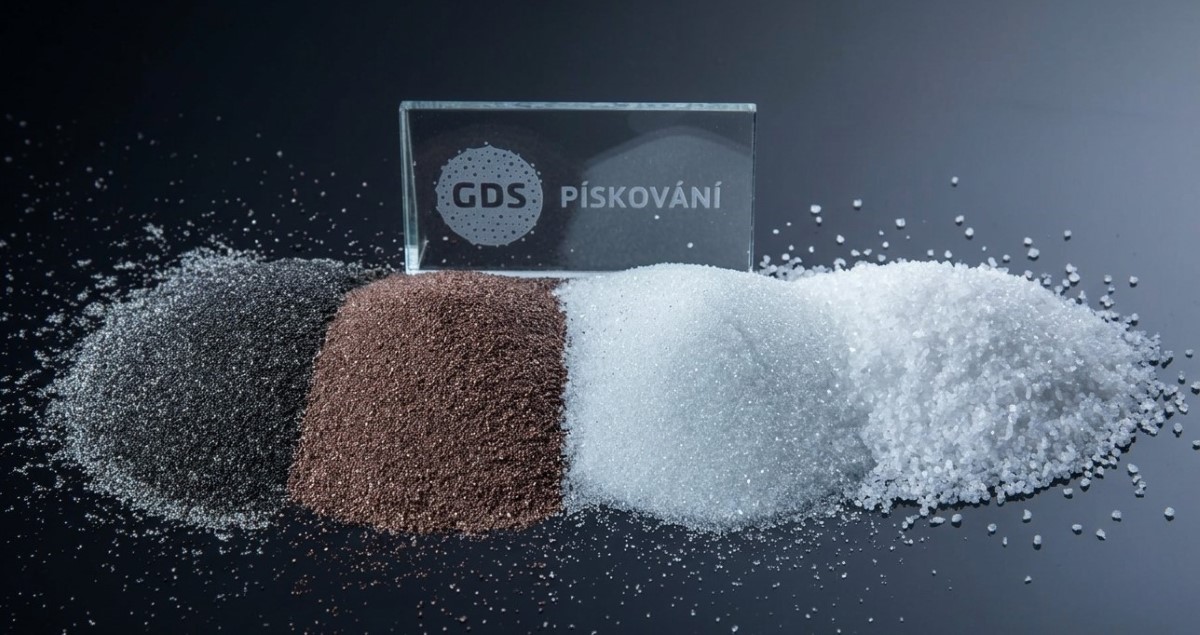
Correct coarseness of abrasive = key to success
Abrasives come in different coarsenesses (fractions). The higher the number, the finer the abrasive and vice versa.
For sandblasting glass, the most commonly used fraction is approx. 120 to 200.
A simple rule also applies when sandblasting:
- the coarser the abrasive, the faster the removal and the rougher the appearance
- the finer the abrasive, the slower the removal, the finer and more detailed the surface
Sandblasting over stencils and what to watch out for
If you are working with sandblasting stencils, care must be taken in selecting the appropriate fraction.
Too coarse an abrasive can:
- sand the stencil
- destroy fine details
Recommendation:
- Normal work: fraction ~180 (150 is possible).
- fine graphics: fraction ~220
For special, durable stencils for deep sandblasting (e.g. photosensitive UltraVinyl film, or MM. or coarse plotter 280 to 420 micron films), coarser material can be used.
What happens to the abrasive during use
The abrasive breaks down and softens during the work. This means that, for example, the 150 fraction gradually "shifts" to a finer fraction
the resulting sandblasting effect also changes.
Special (non-abrasive) fillings
Materials that are not primarily abrasive can also be used in the sandblasting box:
- plastic granulate
- chopped zinc wire
- walnut shells
- glass beads (ballotine)
For example, chopped zinc wire is suitable for removing the coating from the back of mirrors without fogging the glass.
Important: If you combine abrasive and non-abrasive materials, it is very difficult to clean the box perfectly. In practice, therefore, separate boxes are used.
Practical operating tips
- the abrasive needs to be continuously replenished
- some material is lost during extraction
- when using a cyclone, part of the abrasive can be captured and returned
- very fine dust is not reused
If you do not know what to choose, we will be happy to advise you and at the same time we can buy most of the most commonly used abrasivesYou can try out the most common abrasive materials in our GDS ACADEMY training centre or buy the cartridges directly from our e-shop.
Article written by:
David Batla
Owner of GDS Technology s.r.o.

od 1,64 €
od 2,10 €
od 1,64 €
od 2,26 €

Write to us

 Settings