
Can Glass Facades Protect Birds And Inspire Architects at The Same Time?

When Birds See Something in Glass That Isn't There

Modern architecture makes increasing use of large glass surfaces. These bring light, an airy feel, and a visual connection to the surroundings into buildings. For birds, however, they can pose a dangerous obstacle.

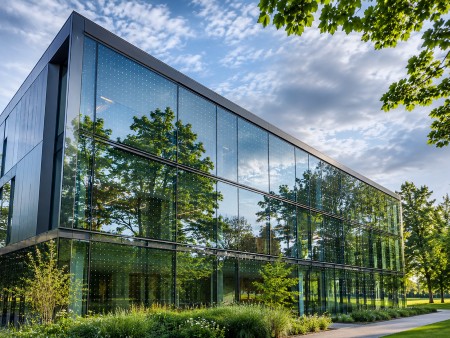
The main problem is the transparency and reflectivity of the glass. Let’s imagine, for example, an office building adjacent to a park. The surrounding trees and the sky are reflected in its glass facade. A bird may perceive the reflection as a continuation of its natural environment and fly into the glass, which it cannot recognize.

The risk, however, is not the same for all buildings. It depends on their location, height, size, and the layout of the glass surfaces, as well as the nature of the surrounding environment and what is reflected in the glass. That is why it is important to assess each building individually.

Bird protection must be considered early on

We have repeatedly heard from our customers about cases where the problem of bird collisions only became apparent after the building was completed and glazed.

At that point, finding a solution becomes significantly more complicated. While retrofit measures do exist, some technologies can no longer be used. A typical example is durable printing with ceramic inks, which are applied to the glass before the tempering process.

It is therefore ideal to address bird protection as early as the architectural design phase. And this is precisely where, in our view, an interesting opportunity for creativity opens up.
Two Ways to Safer Glass

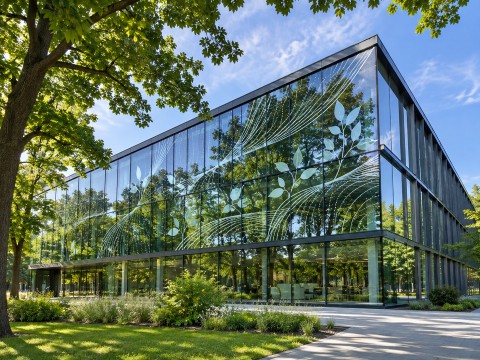
One option is to deliberately incorporate visible graphics directly into the architectural design of the building.

Decorations need not be merely a technical measure; rather, they can be a full-fledged part of the facade’s artistic design.

Geometric patterns, lines, color compositions, or original graphic motifs can give a building a distinctive character while also helping to protect birds.

The second approach, on the other hand, involves making the markings on the glass as inconspicuous as possible. Subtle dots, lines, and other patterns can be designed to minimally disrupt the appearance of the facade and the view from the building, while still being sufficiently recognizable to birds.

In both cases, however, an important principle applies: not every graphic design automatically protects birds. Key factors include, for example, the size and arrangement of individual elements, their contrast, their placement on the glass surface, and the proven effectiveness of a specific solution.

What if birds could see something we can't?

There’s another interesting avenue we’re exploring at GDS.

We’re looking into the possibility of creating a special paint that would be nearly invisible to the human eye but clearly visible to birds. Our approach is based on the fact that the vision of some bird species can perceive parts of the ultraviolet spectrum that humans cannot see.

For now, this is a development project with a number of technical challenges. It will be necessary to verify not only the properties of the paint itself, but above all whether such markings can actually effectively reduce bird collisions with glass.

When Nature Conservation Becomes Inspiration

At GDS, we believe that bird protection need not be viewed merely as yet another requirement that architects and glass manufacturers must address.

What if, on the contrary, it became an impetus for using decorative glass printing even more creatively in architecture?

Today’s glass decoration technologies offer a wide range of possibilities for working with colors, patterns, and surface effects. Properly designed and tested graphics can thus combine the architect’s aesthetic vision with a very concrete benefit for nature conservation.

We would like to help ensure that these possibilities are discussed more extensively already during the design phase of new buildings.

After all , a glass facade can be not only visually beautiful but also more considerate of the life around us.

Article by:
David Batla
Owner of GDS Technology s.r.o.

Contact Us

By submitting the form you agree to the processing of personal data

cookie

We use cookies

We use cookies to help you browse the site, offer personalised content or advertising, and analyse traffic anonymously, which we share with our social media, advertising and analytics partners. You can adjust their settings using the "Cookie settings" link and you can change them at any time in the footer of the website. For more detailed information, please see our Privacy and Cookie Policy.

Do you agree to the use of cookies?

I agree. Disagree Settings
close

We use cookies

To help you browse the site, offer personalised content or advertising and analyse traffic anonymously, we use cookies that we share with our social media, advertising and analytics partners. You can adjust their settings using the "Cookie settings" link and you can change them at any time in the footer of the website. For more detailed information, please see our Privacy and Cookie Policy.

Do you agree to the use of cookies?

Necessary (technical)

Preferential (functional)

Statistical (performance)

Advertising

close

Cookies