 +420 571 612 420
 gds@gds.cz


 EN
EN
 CZ
CZ
 hu
hu
 bg
bg
 fr
fr
 ro
ro


At first glance, white may seem like just one color. In reality, however, different shades of white can vary significantly not only in tone, but also in opacity, gloss, processing technology, or application method. In glass decoration, it therefore often holds true that not all whites are the same. In this article, we will look at the factors that influence the final appearance of white on glass.
1. Introduction – Why White Is Actually a Complex Color
At first glance, white may appear to be just one color. In reality, there are many variations that differ in shade, opacity, gloss, technology, and application method.
- In glass decoration, white often plays a key role:
- design color
- covering layer
- base layer for other colors
- diffusion layer in lighting applications
2. Shade of White: Warm vs. Cool
- Basic classification:
- Yellowish white – white with a warmer, slightly yellowish tone
- Bluish white – cooler white with a bluish tone
- The human eye is very sensitive to these differences
- Different applications prefer different types of white
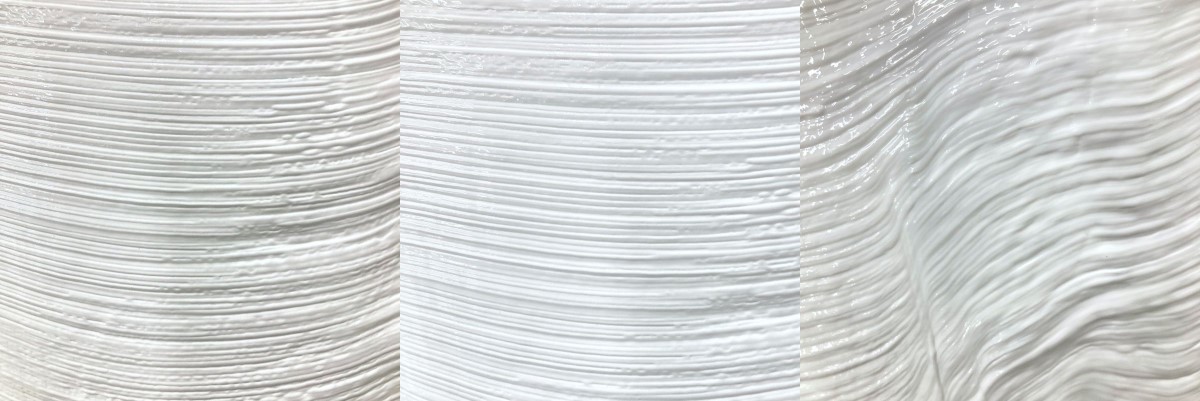
3. Surface Finish – Matte vs. Glossy White
The same shade may appear completely different depending on the surface finish.
Glossy surface = stronger and more saturated appearance
Matte surface = softer and more diffused appearance
4. Opacity of White
Difference between partially transparent and highly opaque white.
- Important, for example, for:
○ covering structural elements
○ masking adhesives or electronics
○ creating a homogeneous base layer
5. Influence of the Type of Glass
The same white may appear different on different types of glass.
- float glass (greenish tint)
- extra clear glass
- textured glass
- satin-finished glass
6. Paint Technology: Organic vs. Ceramic
Glass paints can generally be divided into two main groups:
A) Organic paints
- Processed at lower temperatures
- Allow a wide range of application possibilities
- Often used where high-temperature firing is not required
B) Ceramic paints
• Fired at high temperatures
• After firing they create a very durable layer (fused into the glass)
• Suitable especially for applications with high durability requirements
The choice of the specific paint technology always depends primarily on the type of glass product and its intended use. Different glass industry segments have different requirements in terms of durability, appearance, and processing.
Typical examples include:
- architectural flat glass (interior or exterior applications)
- glass for home appliances
- beverage glass
- decorative glass
- packaging glass
- lighting glass
Each of these segments may require a different type of paint, a different application technology, and a different processing method. Therefore, when selecting a white paint, it is always important to consider not only the desired shade, but also the overall context of the specific application.
7. Influence of the Technological Process (Application, Drying / Firing)
Another very important, but often overlooked factor is the technological process itself.
A) Thickness of the paint layer
The thickness of the applied layer can significantly influence the final appearance of white on glass. With a thicker layer, the paint is typically:
- more opaque
- visually “fuller”
- sometimes slightly different in shade
On the other hand, with a thinner layer the white may become partially transparent, allowing the color of the underlying glass to show through more strongly.
B) Method of paint application
The final thickness of the layer and therefore the appearance of the color is also influenced by the application method, for example:
- screen printing
- roller coater
- spraying
- manual brush application
Each technology creates a different structure and thickness of the layer.
C) Paint dilution before application
The final appearance can also be influenced by the correct viscosity of the paint. If the paint is diluted more before application, the resulting layer may be thinner, which can also change its visual effect.
D) Drying or firing process
For example, with organic paints:
- The recommended drying temperature is usually up to 200 °C, if this temperature is exceeded, the following may occur:
- yellowing
- browning
- change of shade
Therefore, properly set processing conditions are essential for the final appearance of the paint.
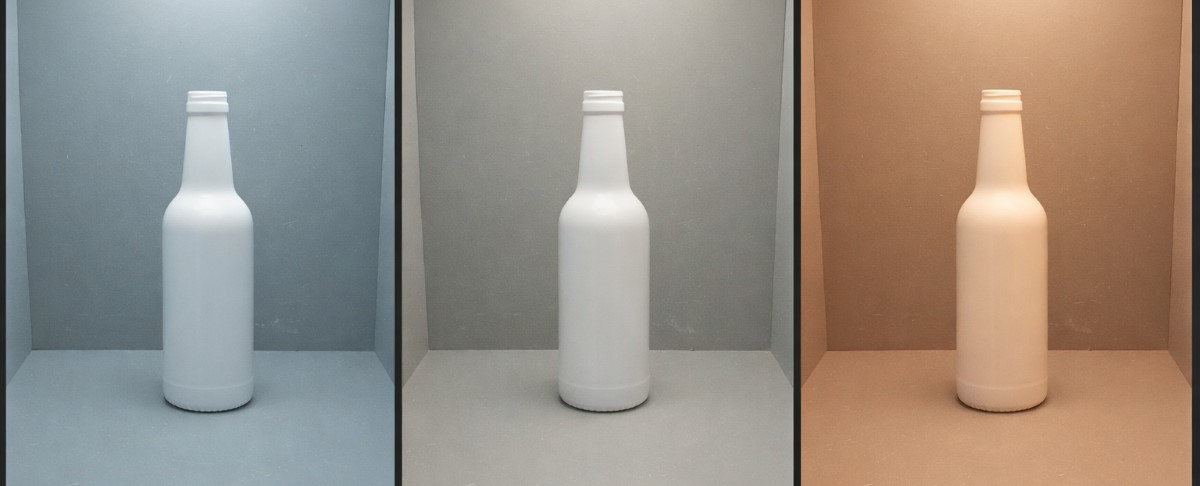
8. Influence of Lighting on the Perception of White
Colors are perceived differently under different lighting conditions.
- D65 – standard daylight (approx. 6500 K)
- T84 – common retail lighting (approx. 4000 K)
- CWF – cool white fluorescent light (approx. 4150 K)
- F/A – classic incandescent bulb (approx. 2700–2850 K)
- U30 – American retail lighting (approx. 3000 K)
- various types of LED lighting
For this reason, professional color evaluation is carried out under standardized lighting conditions.
9) Example of a Special Application: White for Lighting Glass Imitating Opal Glass
Developing a white paint for lighting glass was a major challenge for us because:
- with luminaires it is important not only how the paint looks on the glass
- but also how it behaves when the glass is illuminated
By combining a special organic pigment with a modified production process, we were able to achieve the desired result.
10) Summary
The final appearance of white on glass is influenced by many factors:
- shade of white
- surface gloss
- opacity
- type of glass
- paint technology
- drying or firing process
- lighting conditions
Therefore, it is indeed true that not all whites are the same.
Conclusion:
The final appearance of white on glass is always the result of a combination of pigment, paint technology, application method, glass type, and lighting conditions.
Thanks to our own laboratory and many years of experience, we are able to develop a white shade precisely according to the requirements of a specific application.
If you are not sure which type of white paint is most suitable for your project, we will be happy to help you choose and recommend a solution tailored to your specific application.
Article written by:
David Batla
CEO of GDS Technology s.r.o.


 Settings