 +420 571 612 420
 gds@gds.cz


 EN
EN
 CZ
CZ
 hu
hu
 bg
bg
 fr
fr
 ro
ro


Green solutions are usually associated with increased costs, but there are exceptions. The HGC 3 hybrid paint range offers the opportunity to significantly reduce energy consumption and thus production costs, while at the same time delivering a reduction in CO₂ emissions and a positive environmental impact. Find out why HGC 3 can be a sensible and energy-efficient alternative to the HGC 8 series.
A solution that makes sense economically and environmentally
Energy prices, pressures for production efficiency and the ever-increasing demands to reduce the carbon footprint are being addressed by almost every glass manufacturer today. Yet in the decorative sector in particular, we are often still working with technologies that consume unnecessary amounts of energy.
A proven classic: HGC 8
The HGC 8 series has long been one of the most popular organic, waterborne paints. It is used, for example, for:
- drinking glass
- decorative glassware
- packaging glass for food and cosmetics
- lighting glass
It is a one-component system that requires drying or firing at temperatures of 170-200 °C, with a minimum temperature of 170 °C required for colour thickening.
However, there is a more energy-efficient way
In addition to this range, we have also offered HGC 3 for some time.
This is also an organic, waterborne paint, but this time with two components.
Thanks to this principle:
- no drying at 170 °Cis required.
- the paint thickens even at room temperature (approx. 48 hours)
- in practice, it is normally dried at 80-100 °C, just to speed up the process
The result?
- Energy savings of at least 50% when drying at 80 °C
- Lower production costs
- Significant reduction inCO2 emissions
Money and ecology without compromise
For some people the argument is economics, for others ecology. The HGC 3 series offers both.
- Lower energy consumption
- lower operating costs
- smaller production carbon footprint
Whether you're responding to your own beliefs, customer pressure or internal company goals, this move makes sense.
No risk of shade change
An important message for technologists and production:
All shade formulations from the HGC 8 series can also be implemented in the HGC 3 series without change.
This means:
- No colour changeover.
- no risk of deviations
- no compromise in colour matching
Switching to a more energy-efficient variant therefore does not mean a risk to the product's appearance.
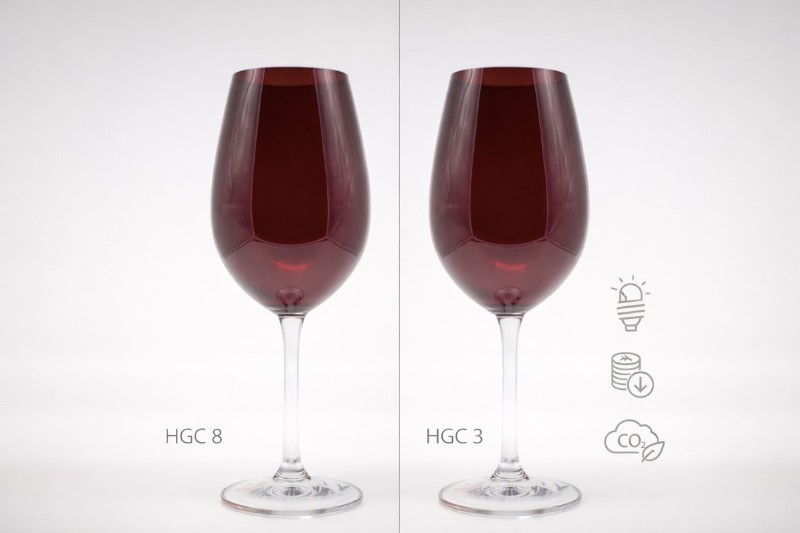
A bonus that can be seen
When looking closely at the decorated surface, for example under a microscope, it can be seen that HGC 3 paints produce a flatter and calmer surface than paints dried at high temperatures.
The result is:
- better optical perception
- higher visual quality of the decoration
This is particularly appreciated by manufacturers of decorative and lighting glass.
This is not a novelty but a proven solution
The HGC 3 series is not a laboratory innovation. We have had it in our portfolio for some time and several manufacturers work with it on a daily basis.
However, today is the right time to reiterate this possibility. The topic of energy saving and CO₂ reduction is more important than ever, and what was previously an alternative is becoming a strategic advantage.
More benefits and another reason to be interested in the HGC3 series
Switching to HGC3 paints doesn't have to be motivated solely by energy savings or environmental considerations. In many cases, it also brings significant practical benefits directly in production.
There are products where it is very difficult to ensure that the entire part is heated evenly to 170-200 °C. These are typically complex shapes or products with variable glass thicknesses. In these cases, if sufficient heating to a minimum of 170 °C is not achieved, the paint will not be fully cross-linked and the resulting decoration may not achieve the required durability. (see our 3-part series on crosslinking)
Conversely, color shade changes may occur when the upper temperature limit is exceeded above 200 °C. This is particularly sensitive for light colours such as white.
Using the HGC 3 series eliminates these concerns. Thanks to a different crosslinking principle, it is not necessary to work within a narrow temperature window, which bringsThis means greater process certainty, a more stable result and fewer risks when producing complex shapes.
Want to try HGC 3 in practice?
If you are interested in this option:
- give us a call and we can discuss your specific application together.
- Try out HGC 3 colours in our GDS Academy training centre
- or sign up for the HGC Paint Spraying course where we will give you a hands-on introduction to the technology
We'll be happy to walk you through if and how switching to HGC 3 might work for you
.
Article written by:
David Batla
Owner of GDS Technology s.r.o.


 Settings